 BookCloud
Keeping a heritage language alive when the books are hard to find
By the BookCloud team · 21 June 2026 · 6 min read
Most families who speak another language at home mean to pass it on. In a 2023 survey, 65% of US Latinos told the Pew Research Center it matters to them that future generations keep speaking Spanish. And yet the language thins out on a fairly predictable schedule: by the third generation — the grandchildren of immigrants — only about a third still speak Spanish well. Spanish is simply the best-counted case; demographers track the same three-generation drift in the United States, among Turkish families across Europe, and in a national study of Australian children alike. Wanting to keep a language and actually keeping it turn out to be two different things.
A language fades by exposure, not by accident
A heritage language doesn't slip because a child loses the ability to learn it. It slips when the everyday input thins out. In a study of nearly 1,900 bilingual families, the linguist Annick De Houwer found that whether children actually spoke the home language tracked how much they heard it, and from whom. When both parents used the minority language at home, most children spoke it; when only one did, the odds fell off sharply. Even the well-known "one parent, one language" rule turned out to be neither necessary nor enough on its own.
It comes down to volume. The amount of each language a child hears predicts how well they speak it, and what families choose to do at home shapes how much of it sticks — for Turkish children growing up bilingual in Europe as much as anyone. The more a child hears the language and gets to use it across ordinary days, the more it holds.
Why it's worth the effort
The cost of letting it go is easy to miss until it arrives. The linguist Lily Wong Fillmore described what can happen when young children drop their first language as they take on the language of school: families lose the common ground to talk about anything that runs deep — grandparents and parents on one side of a language line, children on the other. She called that loss costly to children, families, and society alike. Newer research agrees: children who hold on to the heritage language report closer family ties and a steadier sense of identity.
Two common worries pull the other way, and neither holds up. One is that a second language will set back the first. It doesn't — pediatricians and speech-language specialists are clear that growing up with two languages doesn't cause speech delay or "confusion," and bilingual children reach their milestones on the usual timetable. The other is that the language is the whole of a child's heritage. It isn't — most Latinos say you don't need Spanish to be Latino — but for a lot of families it's the thread that keeps a grandparent's stories, jokes, and pet names within reach. And the case isn't only sentimental: UNESCO treats learning in the mother tongue as a foundation for literacy itself.
The catch: the books barely exist
All of which points back to reading together, one of the steadiest ways to feed a language. In a heritage language, though, the books are usually the hard part — scarce abroad, costly to ship, and rarely the same stories a child meets at school. Researchers who study multilingual families describe parents asking relatives to carry books back from trips and combing the foreign-language shelves of big-city bookshops. For most languages, the supply just isn't there.
What books can — and can't — do
Books have a limit, though. In a 2023 study, Adriana Bus and colleagues gave bilingual preschoolers free access to digital books in their home languages — Turkish, Tamazight, Arabic — and the access on its own didn't change how much they read. Most children gravitated to books in the language of their surroundings, and reading mostly happened alone. The ones who gained vocabulary were the ones actually reading and being read with. It's a small study, so hold it lightly — but it points the same way as everything else.
Handing a child books in the heritage language isn't a switch that flips. What feeds the language is the same thing that feeds any early reading: an adult in the loop. So the workable version looks less like a syllabus and more like a habit:
-
Make it daily and unremarkable — meals, the car, the walk home, the last book before sleep. Little and often beats a weekly lesson. -
Read together in the language and talk about the pictures, even when your child answers you in the other one. The exposure still lands. -
Pull it from more than one place — a second parent, grandparents on a video call, songs, audio. De Houwer's families did best with more than a single source. -
Don't police "mixing." Switching between languages is ordinary and doesn't muddle children. -
Use whatever stories you can get, in whatever form — paper, audio, or screen — and share them.
How we think about it
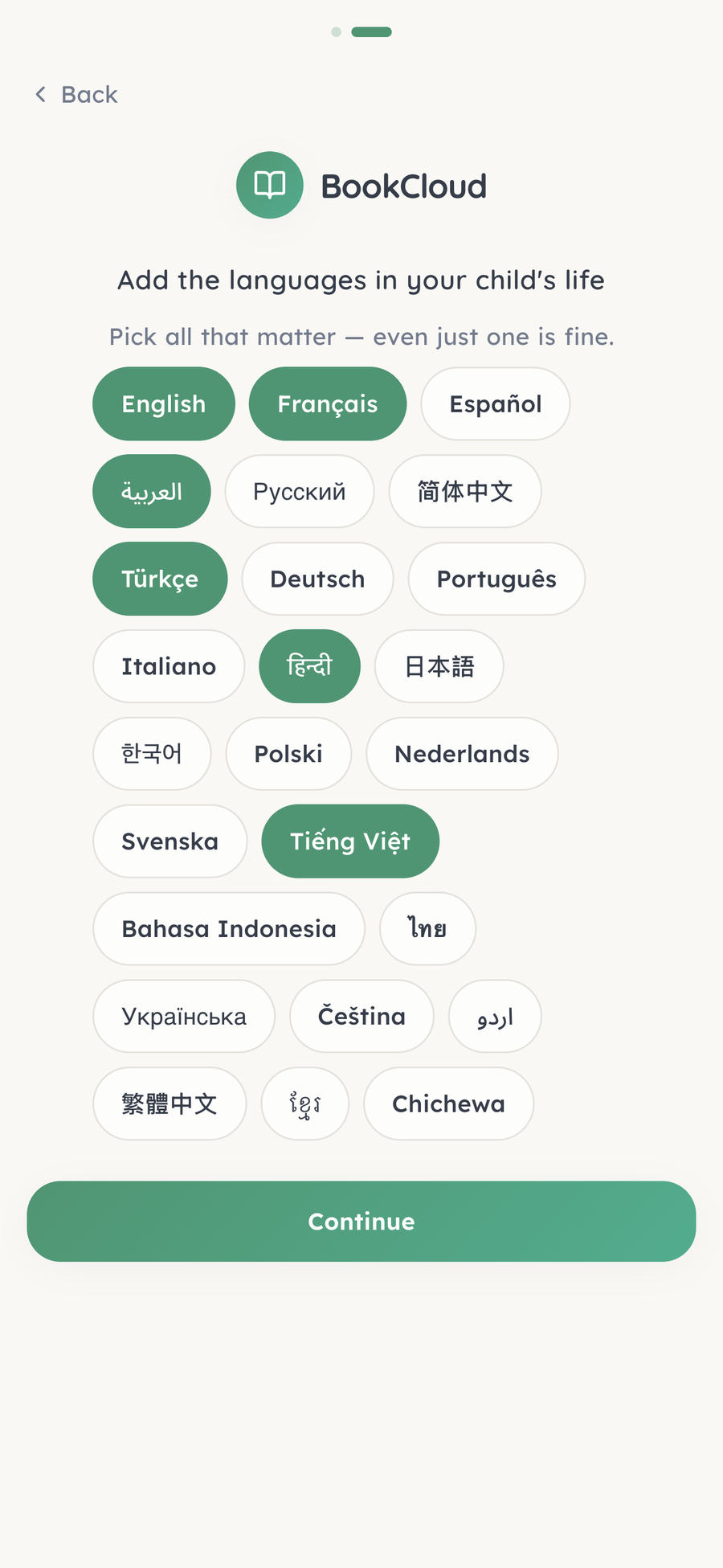
This is the gap BookCloud is built for. The plan is a library that grows language by language, where the same illustrated story exists in each of a family's languages, read aloud — so a child can hear a story in the heritage language even when no one nearby can read it to them, and a parent can read the same book alongside them in either one. Books won't keep a language alive by themselves; that part is you — the talking, the questions, the everyday back-and-forth. What we can do is make the books easier to find.
Stories in your family's languages
Free on iOS and Android, ad-free, read aloud. We're still adding more books, language by language.


Sources
Evidence from the United States, Europe, Australia, the Middle East and international bodies — the same patterns recur across very different languages and places.
How heritage languages fade across generations
- Pew Research Center. "Latinos' Views of and Experiences with the Spanish Language." (2023). US — Spanish proficiency falls across immigrant generations; 65% want future generations to speak it.
- Alba, R., Logan, J., Lutz, A., & Stults, B. "Only English by the Third Generation?" Demography 39(3):467–484 (2002). US — the three-generation model of language shift.
- Sevinç, Y. "Language maintenance and shift under pressure: Three generations of the Turkish immigrant community in the Netherlands." International Journal of the Sociology of Language 2016(242):81–117. Netherlands — the same three-generation shift in Europe.
- Yağmur, K., & Akıncı, M.-A. "Language use, choice, maintenance and ethnolinguistic vitality of Turkish speakers in France." International Journal of the Sociology of Language 164:107–128 (2003). France — intergenerational shift among Turkish speakers.
- Verdon, S., McLeod, S., & Winsler, A. "Language maintenance and loss in a population study of young Australian children." Early Childhood Research Quarterly 29(2):168–181 (2014). Australia — 4,252 children tracked over their first five years (Longitudinal Study of Australian Children).
What keeps it: home input and family choices
- De Houwer, A. "Parental language input patterns and children's bilingual use." Applied Psycholinguistics 28(3):411–424 (2007). Belgium — survey of ~1,900 families; home input patterns predict whether children use the minority language.
- Schwartz, M. "Family Language Policy and Heritage Language Knowledge Among Second Generation Russian–Jewish Immigrants in Israel." Journal of Multilingual and Multicultural Development 29(5):400–418 (2008). Israel — family language choices explain much of children's heritage-language knowledge.
- Hoff, E., Core, C., Place, S., Rumiche, R., Señor, M., & Parra, M. "Dual language exposure and early bilingual development." Journal of Child Language 39(1):1–27 (2012). US — how much of each language a child hears predicts proficiency; total vocabulary keeps pace with monolingual peers.
- Altınkamış, F., & Simon, E. "Language abilities in bilingual children: the effect of family background and language exposure on the development of Turkish and Dutch." International Journal of Bilingualism 24(5–6):931–951 (2020). Turkish–Dutch — how much Turkish children hear at home shapes their proficiency in it.
Bilingual children develop on schedule
- Paradis, J., Genesee, F., & Crago, M. Dual Language Development & Disorders: A Handbook on Bilingualism and Second Language Learning (3rd ed., 2021). Canada — the standard reference on typical bilingual development.
- Nationwide Children's Hospital. "Teaching Kids a Second Language: Can It Cause a Speech Delay?" US — pediatric guidance: bilingualism doesn't cause speech delay or confusion.
Why it matters: family bonds, identity, the mother tongue
- Wong Fillmore, L. "When Learning a Second Language Means Losing the First." Early Childhood Research Quarterly 6(3):323–346 (1991). US — the classic account of the family cost of first-language loss.
- Oh, J. S., & Fuligni, A. J. "The Role of Heritage Language Development in the Ethnic Identity and Family Relationships of Adolescents from Immigrant Backgrounds." Social Development 19(1):202–220 (2010). US — heritage-language proficiency tracks with stronger family ties and clearer identity.
- UNESCO. "Why mother language-based education is essential." International — learning in the mother tongue underpins literacy and inclusion worldwide.
Reading and language growth
- Mol, S. E., & Bus, A. G. "To Read or Not to Read: A Meta-Analysis of Print Exposure from Infancy to Early Adulthood." Psychological Bulletin 137(2):267–296 (2011). Netherlands — 99 studies (N = 7,669): reading and language reinforce each other over time.
- Duursma, E., Augustyn, M., & Zuckerman, B. "Reading aloud to children: the evidence." Archives of Disease in Childhood 93(7):554–557 (2008). UK journal — reading aloud builds language and emergent literacy.
- Bus, A. G., Broekhof, K., & Vaessen, K. "Free access to multilingual digital books: a tool to increase book reading?" Frontiers in Education (2023). Netherlands — among bilingual preschoolers (n = 41), heritage-language book access alone didn't increase reading; family involvement did.
This article is general information for parents, not medical or developmental advice. Every family and every child is different — trust what you see in yours.